Your Home-Buying Guide: Understanding LVR and LMI with SEED LOANS

Your Home-Buying Guide: Understanding LVR and LMI with SEED LOANS

Buying My First HomeNews
November 11, 2025

Your Home-Buying Guide: Understanding LVR and LMI with SEED LOANS

For many first home buyers in Glen Waverley, Melbourne, the dream of owning a home is closer than they think. However, the world of mortgages can feel like a complex process, filled with confusing terms like LVR and LMI.

At SEED LOANS, your dedicated Mortgage Broker team, we believe in making the home loan application process clear, simple, and stress-free. Understanding two key concepts—Loan-to-Value Ratio (LVR) and Lenders’ Mortgage Insurance (LMI)—is essential for securing the best home loan for your financial future.

This guide will break down what these terms mean, compare the pros and cons of an 80% LVR versus a higher LVR, and show you how we can help you navigate these choices.

What is Loan-to-Value Ratio (LVR)?

The Loan-to-Value Ratio (LVR) is one of the most important numbers in your home buying journey. Put simply, it’s a percentage that compares the amount of money you want to borrow against the value of the property you wish to buy.

The LVR Calculation

The LVR is calculated by dividing your loan amount by the property’s value (as assessed by the lender) and multiplying by 100.

LVR = Loan Amount/Property Value x 100
  • Example: You want to buy a house in Melbourne valued at $800,000.
    • If you have a $160,000 deposit, you need to borrow $640,000.
    • Your LVR is ($640,000/$800,000) x 100 = 80% LVR.
  • A simple rule of thumb: A 20% deposit means an 80% LVR.

Why LVR Matters to Lenders

Lenders use the LVR to assess the risk of your mortgage.

  • Lower LVR (e.g., 60% or 70%) suggests a smaller loan relative to the property value, meaning less risk for the lender.
  • Higher LVR (e.g., 90% or 95%) suggests a larger loan relative to the property’s value, indicating a higher risk.

The higher the risk, the more likely the lender will require a form of protection, which brings us to the next crucial term: Lenders’ Mortgage Insurance.

Simple LVR Calculator

🏡 Calculate Your LVR (%)

Your Loan-to-Value Ratio will appear here.

What Does Lenders’ Mortgage Insurance (LMI) Mean?

Lenders’ Mortgage Insurance (LMI) is often misunderstood by new home buyers. It is a mandatory, one-off insurance premium that you, the borrower, pay.

Who Does LMI Protect?

Here’s the key point that must be clear: LMI protects the lender, not you.

If you are unable to meet your mortgage repayments and your property needs to be sold, the lender may not recover the full outstanding loan amount. LMI protects the lender against this potential financial loss.

When is LMI Required?

In Australia, LMI is typically required when your LVR exceeds 80%. This means you have saved a deposit of less than 20% of the property’s value.

While LMI is an additional cost, it serves a huge purpose: it allows people who haven’t saved a full 20% deposit to enter the property market sooner.

How is LMI Paid?

The cost of LMI is usually calculated as a percentage of the loan amount and varies depending on your LVR (the higher the LVR, the higher the LMI). Most borrowers choose to:

  1. Capitalise the LMI: This means adding the premium to your loan amount, so you pay it off over the life of the mortgage (and pay interest on it).
  2. Pay it Upfront: A less common option, but it avoids paying interest on the premium.

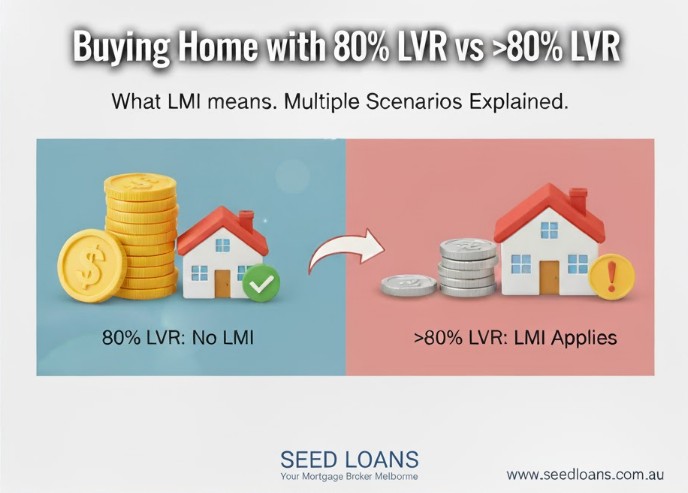
80% LVR vs. >80% LVR: The Decision Point

The LVR threshold of 80% is the dividing line in home finance because it generally dictates whether or not you pay LMI. Let’s compare the benefits and drawbacks of each scenario.

Scenario 1: Buying with an 80% LVR (20% Deposit)

This is often referred to as the ‘Sweet Spot’ for home buyers.

Pros of 80% LVR Cons of 80% LVR
No LMI Cost: You avoid paying the Lenders’ Mortgage Insurance premium, saving you potentially thousands of pounds. Longer Saving Time: It takes significantly longer to save a 20% deposit, especially in a competitive Melbourne real estate market.
Lower Interest Rates: Lenders view this as lower risk, which often qualifies you for their most competitive home loan interest rates and fee structures. Risk of Rising Prices: While you’re saving, property prices may continue to rise, potentially pushing your deposit goal further out of reach.
Better Loan Features: You may gain access to a wider range of loan features, such as offset accounts or interest-only periods. Market Timing: You risk missing out on buying at the “right time” if you wait too long to save the full 20%.

Scenario 2: Buying with a >80% LVR (Less than 20% Deposit)

This path is increasingly common, especially for first home buyers keen to escape the rental cycle.

Pros of >80% LVR Cons of >80% LVR
Faster Entry to Market: You can buy a home sooner with a smaller deposit (e.g., 5% or 10%). LMI Cost: You must pay the LMI premium, which adds to your overall borrowing cost.
Capital Growth: By getting into the market earlier, you start building equity and benefit from any property market growth immediately. Higher Interest Rates: Some lenders may charge a slightly higher interest rate for a higher-risk loan.
Government Schemes: You may be eligible for Government home loan schemes designed for low-deposit borrowers, sometimes allowing you to avoid LMI. Larger Loan Size: Your total loan amount will be bigger, meaning you’ll pay more interest over the loan’s term.

Multiple Scenarios: Finding Your Ideal Strategy

There is no one-size-fits-all answer. Your best deposit strategy depends entirely on your financial situation and your goals.

Scenario A: The Patient Saver (Target LVR 80%)

  • Financial Profile: A couple earning a good income, living affordably, and happy to rent for another 2-3 years.
  • Strategy: Their focus is on saving that full 20% deposit (plus stamp duty and other upfront costs).
  • Outcome: They will avoid LMI, secure a more competitive rate, and have a smaller mortgage overall, leading to lower monthly loan repayments.

Scenario B: The ‘Get In Sooner’ Buyer (Target LVR 90% or 95%)

  • Financial Profile: A single first home buyer in Melbourne who is tired of renting and sees property prices rising quickly. They have a 5% or 10% deposit.
  • Strategy: Borrowing more to get into the property market immediately, accepting the cost of LMI as the ‘price’ of getting on the property ladder now.
  • Outcome: They start building equity sooner and stop paying ‘dead money’ on rent. While they pay LMI, the potential long-term gain from capital growth can outweigh this initial cost.

Scenario C: The Family Support Option (Reducing LVR via Guarantor)

  • Financial Profile: A young couple with a small deposit, but whose parents own a property.
  • Strategy: Exploring a Guarantor Loan or Family Pledge arrangement. A family member offers a portion of their home’s equity as security for your loan.
  • Outcome: They can potentially secure a home loan with little to no deposit and avoid paying LMI, as the overall risk to the lender is secured by the guarantor’s property. This helps them achieve an effective 80% LVR or lower.

Your Next Steps: From Confusion to Clarity

Navigating the choices between an 80% LVR and a higher LVR, and determining if LMI is a smart investment for your future, requires expert advice. This is where SEED LOANS, your trusted Mortgage Broker in Glen Waverley, Melbourne, comes in.

We don’t just process paperwork; we provide you with a bespoke home finance strategy. We will:

  1. Calculate Your True LVR: We’ll factor in all costs, like stamp duty and potential LMI, to give you a clear picture of your borrowing capacity.
  2. Compare LMI vs. Saving: We will crunch the numbers to see if the cost of LMI is financially sound when compared to the potential gain of getting into the market earlier.
  3. Access the Best Rates: As a mortgage broker, we have access to a wide panel of lenders, meaning we can secure the most competitive home loan and interest rate available for your specific LVR.
  4. Explore Options: We will guide you through low-deposit options and Government home loan schemes that could potentially reduce or even eliminate LMI.

Don’t Let the Deposit Hold You Back!

Whether you are aiming for that perfect 20% deposit or you’re ready to buy a home sooner with a smaller amount, the path to homeownership begins with a conversation. The property market waits for no one, and delaying action might mean paying more later.

Take control of your financial future today. Let the experts at SEED LOANS provide you with a tailored mortgage solution that turns your homeownership dreams into reality.

Ready to find out your best LVR strategy and secure your ideal home loan?

Contact SEED LOANS today to start your homeownership journey. Phone: 0403 323 436 Facebook: https://www.facebook.com/SeedHomeLoansMortgageBroker

Home Guarantee Scheme Price Cap from 1st Oct 2025

According to Housing Australia, the property price caps for the First Home Guarantee and Regional First Home Buyer Guarantee will be increasing on October 1, 2025. This change, along with the removal of place limits and income caps, is designed to help more Australians enter the housing market.

Here are the new property price caps, effective October 1, 2025:

  • New South Wales – capital city and regional centre: $1,500,000
  • New South Wales – other: $800,000
  • Victoria – capital city and regional centre: $950,000
  • Victoria – other: $650,000
  • Queensland – capital city and regional centre: $1,000,000
  • Queensland – other: $700,000
  • Western Australia – capital city: $850,000
  • Western Australia – other: $600,000
  • South Australia – capital city: $900,000
  • South Australia – other: $500,000
  • Tasmania – capital city: $700,000
  • Tasmania – other: $550,000
  • Australian Capital Territory: $1,000,000
  • Northern Territory: $600,000
  • Jervis Bay Territory and Norfolk Island: $550,000
  • Christmas Island and Cocos (Keeling) Islands: $400,000

Source: Housing Australia, “Unlimited places, higher property price caps for first home buyers from 1 October 2025” – https://www.housingaustralia.gov.au/media/unlimited-places-higher-property-price-caps-first-home-buyers-1-october-2025

Meet the team

Speak directly to us, just make sure to include all your contact details for us to get back to you as soon as possible.

Any advice contained in this article is of a general nature only and does not take into account the objectives, financial situation or needs of any particular person. Therefore, before making any decision, you should consider the appropriateness of the advice with regard to those matters. Information in this article is correct as of the date of publication and is subject to change.